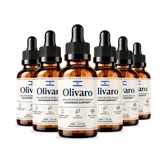
Olivaro Proprietary Blend: 22 Ingredients in 200 mg
Quick answer
Olivaro lists chromium at 0.7 mcg and then 22 ingredients inside a single 200 mg proprietary blend, with no amount shown for any one of them. Split evenly that is about 9 mg each, far below the doses used in most studies. The order of the list shows maca is the largest ingredient, so treat Olivaro as a gentle, low-dose botanical formula rather than a high-dose one.*
What the label actually says
Olivaro’s Supplement Facts panel has only two lines that carry a dose. Chromium (as chromium picolinate) is listed on its own at 0.7 mcg. Everything else sits under one heading: a proprietary blend of 22 ingredients, 200 mg in total per 1 ml serving. That is the whole disclosure. You get a total weight and a list of names, with no amount next to any single ingredient.
This is legal and very common. Federal rules let a company list a blend by its combined weight and keep the individual amounts private. What the rules do require is that the ingredients inside the blend are listed from most to least by weight (FDA: dietary supplements). That ordering is the one real clue hiding in plain sight, so it is worth using.
What the order tells you
Here is the blend as printed: maca root, grape seed, guarana seed, African mango seed, eleuthero root, astragalus root, green tea leaf, gymnema leaf, coleus root, capsicum fruit, grapefruit fruit, Panax ginseng, raspberry ketones, then L-glutamine, L-tyrosine, L-arginine, beta-alanine, a licorice compound, GABA, L-ornithine, L-tryptophan and L-carnitine.
Two things stand out. Maca comes first, so it is the biggest single ingredient by weight. And gymnema (eighth) and Panax ginseng (twelfth), the two that most blood sugar marketing leans on, sit in the middle of the pack, while every amino acid is in the back half. Nothing sinister in that. It simply tells you the formula leans on botanicals for energy and stamina first and glucose-specific ingredients second.
The math most reviews skip
Divide 200 mg by 22 and you get roughly 9 mg per ingredient. The real split will not be even, since maca is presumably well above that and the tail well below, but the average is the number to keep in your head. Now compare it with what the research literature describes:
| Ingredient | Amounts typically discussed in research | Olivaro |
|---|---|---|
| Chromium | Studies often use 200 to 1,000 mcg a day (NIH ODS) | 0.7 mcg, listed separately |
| L-carnitine | Supplements commonly supply 500 to 2,000 mg (NIH ODS) | Last in the blend, under 9 mg on average |
| Panax ginseng | Trials use grams of root or hundreds of mg of extract (NCCIH) | About 9 mg on average |
| Green tea | Extract trials usually use hundreds of mg (NCCIH) | About 9 mg on average |
| Gymnema | Trial extracts are typically in the hundreds of mg (PubMed) | About 9 mg on average |
These are ballparks, not exact figures, because extract strength and form vary a lot. But the arithmetic holds even if the split is wildly uneven: 200 mg cannot contain a study-level dose of more than one or two of these ingredients.
Does that mean it does nothing?
No, and anyone who says “underdosed, therefore useless” is overreaching as much as the ads are. A concentrated extract goes further than a plain powder, and the label does not tell us which form is used. Nobody has tested this finished blend either (what we found when we searched). So the fair summary is this: Olivaro is a broad, low-dose botanical and amino acid formula whose effect on blood sugar has not been demonstrated.
Who it still makes sense for
If you want a gentle once-a-day routine, dislike capsules and are comfortable judging it yourself inside a 60-day guarantee, the low dose is not a dealbreaker. It may even be a plus if you are cautious about strong herbs (Olivaro for seniors). If you want a proven dose of one specific ingredient, buy a product that prints that dose. Chromium pills and berberine are the honest examples.*
Five questions for judging any blend
- What is the total weight, and per how much liquid or how many capsules?
- How many ingredients share it? Divide.
- Which ones come first? That is where most of the weight sits.
- Does anything on the list have a study-level dose? If you cannot tell, assume not.
- What happens if it does not suit you? A real refund policy matters more than a clever formula (how Olivaro’s works).
What to ask support before you order
You are allowed to ask for more than the label gives. Email support and request the per-ingredient amounts, the extract type for each botanical and the name of the manufacturing facility. Contact options are in our contact guide. If they decline to share, that is not proof of anything, but it is information you can weigh. The NIH’s advice on using supplements wisely starts with the same idea: know what is in the bottle (NCCIH: using dietary supplements wisely).
Our bias, stated plainly
We earn a commission if you order through our links. We would still rather you buy knowing the blend is low-dose than buy believing otherwise and ask for a refund in week six. For the line-by-line label, see the Olivaro label explained.
Olivaro FAQ
Is a proprietary blend a red flag?
It is a reason to look closer rather than proof of a problem. Blends let a company keep amounts private, which also makes it impossible to check for study-level doses.
Can I find out how much of each ingredient is in Olivaro?
Not from the label. You can email support and ask for per-ingredient amounts; whether they share them is their choice.
Why is maca listed first?
Ingredients inside a blend must be listed from most to least by weight, so maca is the largest single ingredient in Olivaro’s blend.
Is 0.7 mcg of chromium enough?
Studies of chromium typically use 200 to 1,000 mcg, so 0.7 mcg is a tiny amount. See Olivaro vs chromium pills.